We earn a commission if you buy through our links, at no extra cost to you.
Swing Sets for Small Backyards: Footprint and Space
How much yard a swing set really needs. Footprints, CPSC use zones and swing lanes worked out for four compact sets from Backyard Discovery and Gorilla Playsets.
At a glance
For a small yard, Backyard Discovery Buckley Hill gives a deck, 6-foot slide and swings in 123 by 107 inches. Backyard Discovery Durango is smaller if you only want swings, and Backyard Discovery Tanglewood adds a clubhouse. Allow 6 feet of clear space on every side and extra length in front of and behind the swings.
A swing set looks small in the store photos and large in the yard. The footprint listed on the box is only part of the story, because safety guidance asks for clear space on every side and a long lane in front of and behind the swings. This guide works through the real space needed for four of the more compact sets in our swing set ranking, using the makers’ published dimensions and the Consumer Product Safety Commission’s home playground handbook. The arithmetic is ours, and where a maker does not publish a figure we say so.
We do not test products ourselves. Dimensions come from the makers’ product pages, and the clearance rules come from the CPSC handbook.
The Space Rules in Plain English
The CPSC handbook gives three rules that decide how much yard you need.
- 6 feet around the equipment. Place the set at least 6 feet from any structure or obstacle, such as a house, fence, shed, tree or pole.
- Surfacing 6 feet beyond the perimeter. Shock-absorbing surfacing should go under the set and at least 6 feet beyond it. The handbook suggests at least 9 inches of loose fill such as wood mulch, engineered wood fiber or shredded rubber mulch for equipment up to 8 feet high, and says grass and concrete do not qualify.
- Twice the beam height for swings. In front of and behind the swings, the clear distance is twice the height of the top bar from which they hang.
Rule 3 is the one people miss. A frame that is 8 feet deep with a 7-foot beam needs 14 feet of clear space on each side of the swing path, which turns an 8-foot frame into a lane of about 36 feet.
The ground should also be level and drain well. Gorilla’s page says the area under its set should be cleared and level within 3 inches before assembly.
The Numbers at a Glance
Footprints are the makers’ published sizes. The “cleared area” adds 6 feet on every side. The swing-lane figure uses the overall height as a ceiling for the beam height, because most makers do not publish the beam height. The real lane is shorter, and your manual will give the beam height.
| Set | Footprint | Cleared area (6 ft all round) | Swing lane ceiling |
|---|---|---|---|
| Backyard Discovery Durango | 9 ft 1 in by 8 ft 1 in | about 21 ft 1 in by 20 ft 1 in | about 36 ft |
| Backyard Discovery Buckley Hill | 10 ft 3 in by 8 ft 11 in | about 22 ft 3 in by 20 ft 11 in | about 40 ft |
| Backyard Discovery Tanglewood | 14 ft 7 in by 12 ft | about 26 ft 7 in by 24 ft | about 47 ft |
| Gorilla Playsets Double Down II | 15 ft 6 in by 13 ft | 28 ft by 25 ft (Gorilla’s figure) | beam height 7 ft 2 3/4 in per the manual |
These are rectangles of level ground. In a yard with a patio, a tree or a slope, the usable area is often smaller than the lot suggests, so measure what is actually clear.
Backyard Discovery Durango
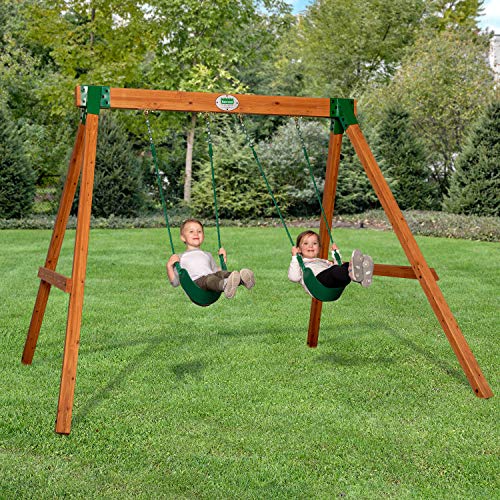
The smallest footprint in this guide: a cedar A-frame with two belt swings, for families who want swings and nothing else.
The Durango is 109.2 inches wide, 97.2 inches deep and 84 inches high, and it weighs 106.93 lbs. It has two belt swings with pinch-free ropes, reinforced steel corner supports and four auger anchors for each leg, and Backyard Discovery says it assembles in 2 hours or less. It is designed for up to 2 kids and lists ages 3 to 10. With 6 feet added all round you need roughly 21 by 20 feet, and the swing lane is about 36 feet end to end if the swings face along the 97-inch depth.
The tradeoff is simple: no deck, no slide. See the Durango profile.
Backyard Discovery Buckley Hill
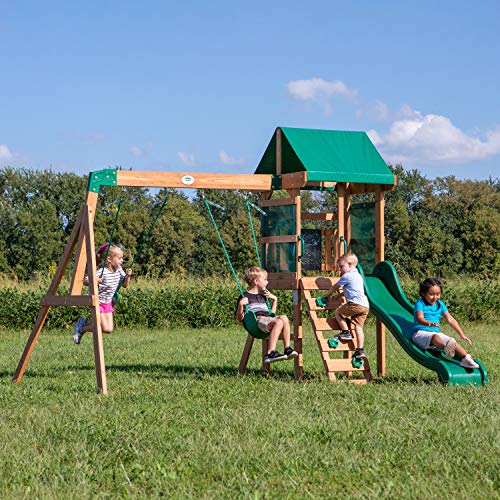
A deck, 6-ft slide, rock wall ladder and two swings in the smallest footprint of any set here with a slide.
At 123 by 107 by 92 inches, the Buckley Hill adds a raised play deck with a canopy roof, a rock wall ladder with 4 holds, a 6-foot wave slide and a chalkboard to the swings. It ships as one box at 145.51 lbs. Backyard Discovery calls it an ideal starter set for young children and says it is designed with play areas for up to 5 kids. Cleared area is about 22 ft 3 in by 20 ft 11 in. The swing lane tops out near 40 feet. The Buckley Hill profile has the details.
Backyard Discovery Tanglewood
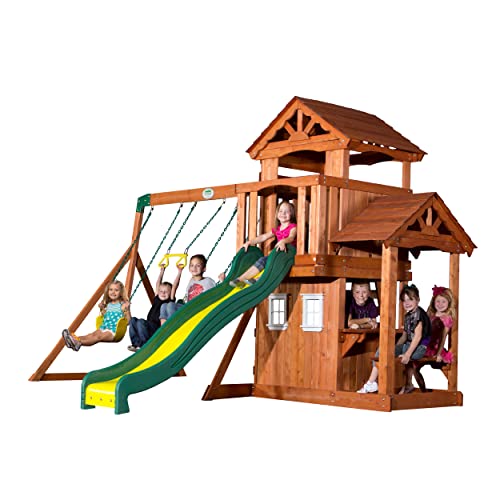
A clubhouse, lower playhouse, snack bar and 8-ft slide for a medium yard that is a step up from a starter set.
The Tanglewood is 175 by 144 by 105.75 inches and 350.53 lbs. It brings an upper clubhouse, a lower playhouse, a covered snack bar, a rock wall ladder with 6 holds, an 8-foot wave slide, two belt swings and a trapeze. Backyard Discovery says it is designed for up to 7 kids. The cleared area is about 26 ft 7 in by 24 ft, so this is a medium-yard set rather than a small-yard one. See the Tanglewood profile.
Gorilla Playsets Double Down II
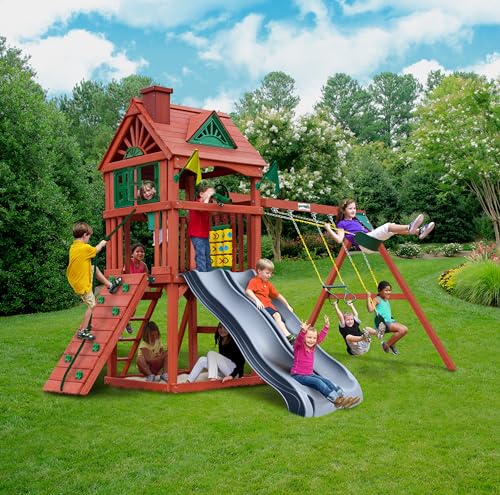
Two wave slides, a rock wall and a trapeze in a set Gorilla sizes at 28 ft by 25 ft including its perimeter.
Gorilla lists the Double Down II at 15 ft 6 in wide, 13 ft deep and 10 ft 6 in high, and recommends a 6-foot safety perimeter for a total of 28 by 25 feet. The manual lists the swing beam at 7 ft 2 3/4 in, which makes twice that distance about 14 ft 5 1/2 in in front of and behind the swings. Gorilla recommends it for ages 3 to 11. It is the biggest of the four, and the one to consider only if your yard is on the roomier side. See the Double Down II profile.
How to Measure Your Yard
- Pick the level spot and measure its width and depth in feet and inches.
- Check the distance from that spot to fences, sheds, trees, posts and the house.
- Work out the swing direction. With a 7-foot beam, the CPSC rule asks for 14 feet of clear space in front of and behind the swings, so a fence 10 feet away is too close.
- Allow for surfacing: 6 feet beyond the perimeter, and a depth of at least 9 inches of loose fill for sets up to 8 feet high.
- Compare your clear rectangle with the cleared-area column above.
If the swing lane does not fit, turn the set so the swings face the longest clear direction, or choose a smaller set. If you are not sure, mark the cleared area with stakes and string before ordering.
Everyday Habits After the Build
The CPSC handbook recommends checking nuts and bolts twice a month, inspecting swing seats, ropes and chains monthly, keeping S-hooks closed, raking surfacing so it does not compact, and supervising children at all times. The cedar sets may need a sealant that is not included, according to Backyard Discovery, so read the manual.
Which One for Your Yard
- Under about 22 by 21 feet clear: Durango (swings only) or Buckley Hill (slide and deck).
- About 26 by 24 feet clear: Tanglewood.
- About 28 by 25 feet clear: Double Down II.
Sources
- Backyard Discovery Durango official product page
- Backyard Discovery Buckley Hill official product page
- Backyard Discovery Tanglewood official product page
- Gorilla Playsets Double Down II official product page
- Gorilla Playsets Double Down II assembly manual (PDF) (source of the swing beam height)
- CPSC Outdoor Home Playground Safety Handbook (PDF)
Frequently asked questions
How much yard do I need for a swing set?
Add 6 feet on every side of the set's footprint, per the CPSC handbook, and more in front of and behind the swings. For the compact sets here, the cleared area runs from about 21 by 20 feet for the Durango to about 28 by 25 feet for the Gorilla Double Down II.
Can a swing set go close to a fence?
The CPSC handbook says to locate play equipment at least 6 feet from any structure or obstacle such as a house, fence, shed, tree or pole. Swings need more room to the front and back: twice the height of the top bar they hang from.
What is the smallest swing set with a slide?
Among the sets we cover, the Backyard Discovery Buckley Hill is the smallest with a deck and slide, at 123 inches wide by 107 inches deep, according to Backyard Discovery. Its slide is 6 feet long.
Does the ground need to be flat?
Yes. The CPSC handbook recommends level, well-drained ground, since slopes and standing water cause loose-fill surfacing to wash away. Gorilla's page says the area should be cleared and level within 3 inches before assembly.
What goes under a swing set?
Protective surfacing such as wood mulch or chips, engineered wood fiber, shredded rubber mulch, sand, pea gravel or rated rubber. The handbook recommends at least 9 inches of loose fill for equipment up to 8 feet high, extending at least 6 feet beyond the structure.
Is a small yard a problem for swings?
Swings are what take up the most room. A frame that is only 8 feet deep can still need a swinging lane of 30 feet or more end to end under the CPSC rule, so measure the swing direction first.