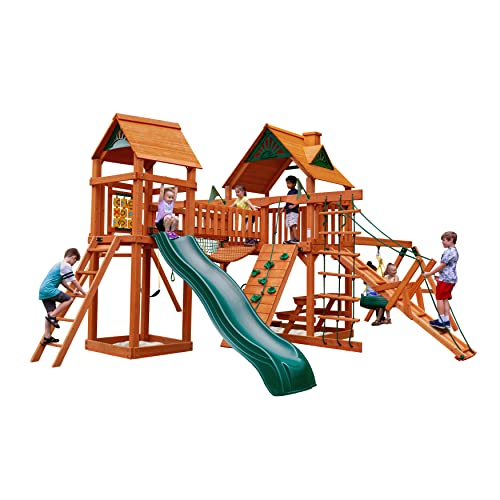
The Gorilla Playsets Pioneer Peak is one of the largest cedar swing sets on our site. It pairs two play towers and a clatter bridge with a rock wall, a wave slide, a built-in picnic table and a full swing beam, so it is meant to be a backyard centerpiece rather than a starter set. This profile walks through what Gorilla publishes about it, how much yard it needs, how it goes together, what the upkeep looks like, and who is likely to be happy with it. For the wider field, see our ranking of the best swing sets of 2026.
We do not test products ourselves. Everything below comes from Gorilla’s product page, Gorilla’s assembly manual and the CPSC’s home playground handbook, and where a number is unclear we say so.
What Gorilla Says About the Pioneer Peak
The Amazon listing for this ASIN is the Wood Roof version. According to Gorilla’s product page, the set includes:
- Two towers joined by a clatter bridge with mesh panels, with a main platform of 4 ft by 6 ft, a tower platform of 3 ft by 3 ft and a platform height of 5 ft.
- An Alpine Wave Slide, a rock wall with a climbing rope, a safe-entry ladder, a deluxe rope ladder and a deluxe climbing ramp.
- A Turbo Tire Swing with swivel on its own 4x6 one-position beam, plus two belt swings and a trapeze on a 4x6 three-position beam.
- A built-in picnic table, one sandbox area and a bonus sandbox area under the tower (sand is not included).
- A tic-tac-toe panel, steering wheel, play telescope, flag kit and safety handles.
- Cedar framing, with the framing posts available in natural cedar or cedar with an amber finish.
Gorilla describes the cedar as naturally resisting rot, decay and insect damage. It also states plainly that the set is for residential use only.
Size and the Yard Space It Needs
This is the number that decides most purchases. Gorilla lists the assembled set at 23 ft wide, 11 ft tall and 22 ft 6 in deep. Gorilla’s page says to allow a minimum 6 ft safety perimeter around the playset, and elsewhere on the page says the whole play area must be cleared and level to within 3 in before assembly.
The CPSC’s Outdoor Home Playground Safety Handbook is more specific about how that perimeter works. It says to locate play equipment at least 6 ft from any structure or obstacle such as a house, fence, garage or tree, and to leave extra room in front of and behind swings, a distance equal to twice the height of the top bar from which the swing is suspended. It also says protective surfacing should extend at least 6 ft beyond the equipment in all directions.
Put together, the arithmetic looks like this:
- Set footprint: 23 ft by 22 ft 6 in.
- Adding 6 ft on every side: about 35 ft by 34 ft 6 in, or roughly 1,200 square feet of level ground.
- Swing zone: the older Gorilla manual we read lists a swing beam height of 7 ft 7 1/2 in, and twice that is about 15 ft 3 in in front of and behind the swings. Check the site plan in the manual that ships with your set to see which direction the swing beam faces and how that overlaps with the published depth.
If your yard is under about 40 ft in either direction once you subtract fences, sheds and trees, this is not the set for you. Our swing set ranking and the smaller Gorilla Double Down II are better starting points for tighter lots.
Climbing, Sliding and Swinging
The Pioneer Peak packs in a lot of different ways to climb. The rock wall with rope, the rope ladder, the safe-entry ladder and the deluxe ramp give kids at several skill levels a way up. Gorilla describes the ramp as an easier way to reach the second-story play deck, which matters for younger kids at the bottom of the age range and for anyone who simply wants a gentler route.
On the swinging side, giving the tire swing its own one-position beam keeps it from competing with the belt swings and trapeze for space, and it lets more than one child ride. Gorilla’s manual caps the tire swing at 125 lbs total weight, so the “more than one child” part has a hard limit, and a group of bigger kids can exceed it quickly.
The clatter bridge between the two towers is the feature that sets this set apart from a single-fort design. Gorilla notes the bridge has mesh panels for visibility, which also helps adults watch from the patio or the yard.
Weight Limits and Ages
According to Gorilla’s 2016 Pioneer Peak assembly manual, which covers the tarp-roof version of the set, the product is recommended for children ages 3 to 11. The manual lists these limits and says they must not be exceeded:
- Fort platforms: 800 lbs total weight.
- Swing belt: 225 lbs, although the manual notes that 150 lbs is the maximum recommended swinging weight for each swing position.
- Trapeze: 125 lbs.
- Tire swing: 125 lbs total weight.
- Rope ladder: 75 lbs.
- Rock wall and climbing ramp: 150 lbs each.
- All slides: 150 lbs.
- Maximum swing beam load: 425 lbs.
That 2016 manual is for the tarp-roof layout, so treat these numbers as Gorilla’s published limits for the Pioneer Peak line and confirm them against the manual in your box. Remember that the set is recommended for children ages 3 to 11, so the component ratings are ceilings, not an invitation for adults to climb on. Kids at the top of the 3 to 11 range are the ones most likely to push the ramp, wall and slide limits, so a family with a 10- or 11-year-old and several friends should read these numbers closely.
Assembly and Installation
Gorilla’s page lists 11 boxes and 12 to 15 hours of assembly, though the field is mislabeled on the page. The older tarp-roof manual estimates 16 to 20 hours, so plan for a long weekend or two, with at least two adults. Gorilla’s page also offers professional installation in some areas (availability depends on your zip code, and scheduling lead times are listed on the page).
A few practical points from Gorilla’s manual and the CPSC handbook:
- Level the site before you start. Gorilla’s manual explains that a set settles into the soil as children play, so it needs to sit level and true, and it advises checking that each year.
- Follow the manufacturer’s anchoring instructions. The CPSC handbook says play equipment may need anchors to keep it from tipping while in use, and that anchors should be buried or covered with surfacing.
- Plan the surfacing before the set arrives, since mulch or sand has to be ordered and spread around a very large footprint.
Materials and Upkeep
Cedar is the draw and the chore. It resists rot and insects, but it still weathers, checks and fades like any outdoor wood. Gorilla’s manual and page set out the owner’s job:
- Within the first 60 days, check and tighten the bolts, T-nuts and lag screws, then repeat twice a year, once before the season and once during it.
- Within the first 90 days, apply a sealant or a semi-transparent stain with sealant. Gorilla’s page notes you may need more than one gallon because of the wood’s texture and porosity.
- Seal once or twice a year after that, depending on climate, and inspect wood monthly for lifted grain or splinters.
- Per the CPSC handbook, check swing seats, ropes and chains monthly for wear, and check nuts and bolts twice a month during the season.
- In very cold weather, Gorilla’s manual advises removing the swing belts and other pliable parts, and taking plastic swing seats indoors when temperatures drop below 32°F.
Compare this to a Lifetime Adventure Tower Deluxe, which is built from plastic and steel and needs no staining. Cedar looks better and feels more like a classic backyard playset, but the upkeep is real.
Warranty
According to Gorilla’s product page, the Pioneer Peak carries a limited 10-year warranty on lumber and 1 year on accessories. The warranty text in Gorilla’s manual says cosmetic effects of wood, including peeling, splintering, warping and seasonal checking, are not covered. Neither are fading of stain, mold, rot from poor drainage, or damage from improper installation. The warranty is also void for commercial, institutional or multi-family use and is not transferable. Read it before you buy and keep proof of purchase.
How It Compares With Neighbors
Against the Gorilla Double Down II, the Pioneer Peak is the bigger, more varied option: two towers, a bridge, a tire swing and a ramp where the Double Down II has one clubhouse and two side-by-side slides. The Double Down II needs about 28 ft by 25 ft of total space against roughly 35 ft by 34 ft 6 in here, and it assembles in a fraction of the time.
Against the Backyard Discovery Montpelier, another large cedar set, the Pioneer Peak is bigger and has a bridge and tire swing, while the Montpelier has monkey bars, a balcony clubhouse and a 5-year warranty.
Against the Lifetime Adventure Tower Deluxe, the trade is wood against plastic and steel. Lifetime rates its towers for ages 3 to 12 and promises no staining, painting or sanding, but its play features are fewer and its footprint is smaller. The Pioneer Peak has more to do, more to maintain and a longer wood warranty.
Who Should Buy It
- Families with a large, level yard who want a destination play set rather than a compact one.
- Parents of several kids in the 3 to 11 range who want different ways to climb and swing.
- Buyers who like real cedar and are willing to seal it and check hardware on a schedule.
- Households that can pay for professional installation or have two or three capable adults and a long weekend.
Who Should Skip It
- Anyone with a small or sloped yard, or one with mature trees, fences or a shed within the required perimeter.
- Families who want a low-maintenance set with no staining.
- Parents of children under 3, since Gorilla does not rate the set for that age.
- Families with older kids near or beyond 11, who may outgrow it or run into its weight limits.
Before you order, measure the yard, mark out the footprint and the 6 ft perimeter with stakes and string, and make sure the surfacing material and a delivery spot for 11 boxes are lined up. Setup and supervision matter more than any feature list, and the manufacturer’s manual and the CPSC handbook are the documents to follow.
Sources