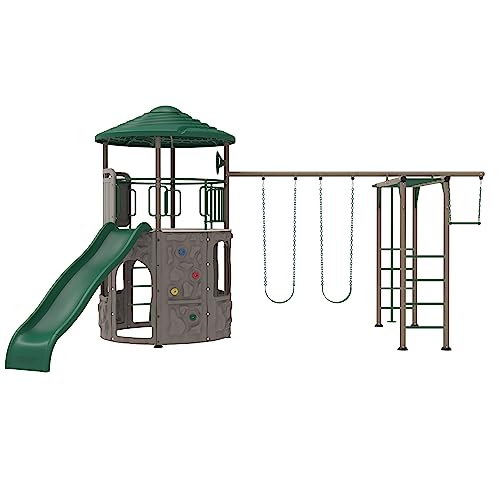
The Lifetime Adventure Tower Deluxe, model 91199, is a plastic-and-metal playset that leans on climbing: monkey bars, a fireman’s pole, two rock-style climbing walls, a ship’s wheel and a covered clubhouse with a 9-foot wavy slide. It also has two belt swings and a trapeze. This profile covers what Lifetime publishes about it, how much yard it needs, how it goes together and what upkeep to expect. For the full field, see our ranking of the best swing sets of 2026.
We do not test products ourselves. The details here come from Lifetime’s product page and the English sections of its assembly manual, along with the CPSC’s home playground handbook.
What Lifetime Says About the Adventure Tower Deluxe
According to Lifetime, the set includes:
- A 9-foot wavy slide made of UV-protected HDPE plastic.
- Monkey bars, a fireman’s pole and two sturdy rock-style climbing walls.
- A covered clubhouse with a heavy-duty hardtop roof and a lookout.
- A ship’s wheel and an integrated car map on the tower floor.
- Two belt swings and a trapeze bar, with rubber-coated chains to prevent pinching and snagging.
- A free-standing design that needs no cement.
In its product description, Lifetime says a double-wall high-density polyethylene structure and galvanized, powder-coated steel are meant to keep the playset from warping, rotting or splintering.
Lifetime also says that hard edges and corners are rounded or covered with plastic caps, that no lead-based material is used, and that the set “passes playground performance and safety standards.” The page does not name a specific standard, so we do not either. The page also says the playset is UV-resistant and retains strength and color, and that it will not crack, warp, rot or splinter.
Size and the Yard Space It Needs
This is the practical question for most buyers. Lifetime’s manual lists the playset dimensions as 16 ft 2 in by 19 ft 6 in and the recommended play area as 32 ft 6 in by 33 ft 3 in. That is a little over 1,080 square feet of clear, level ground.
The manual also spells out the rules behind that rectangle:
- Place the equipment on level, well-drained ground, not less than 6.6 ft (2.0 m) from any structure or obstruction such as a fence, garage, house, overhanging branches, laundry lines or electrical wires.
- Make sure the clearance in front of and behind the swings is at least twice the height of the swing bar.
- Make sure the impact surfacing covers the entire recommended play area.
The CPSC handbook gives nearly the same guidance: at least 6 ft from any structure or obstacle, extra space in front of and behind swings equal to twice the height of the top bar, and surfacing that extends at least 6 ft beyond the equipment in all directions. Lifetime’s number is slightly more generous, at 6.6 ft.
One more placement note from the manual: a slide can get hot in direct sunlight, and Lifetime says it is not recommended to install a slide facing the sun. Point the slide toward shade or away from the afternoon sun.
For a tighter lot, the base Lifetime Adventure Tower has a recommended play area of about 31 ft 10 in by 31 ft 6 in, which saves only a little, so a small yard may need a different set altogether.
Climbing, Sliding and Swinging
What sets the Deluxe apart from Lifetime’s base tower is its climbing gear. Monkey bars and a fireman’s pole add ways to move around that the base model does not list on its product page, and the two rock-style walls give kids more than one route up. That variety matters for older kids, who tend to lose interest in a swing-and-slide-only set sooner.
The covered clubhouse is the other draw. A hardtop roof, a lookout, a ship’s wheel and a car map on the floor are the pretend-play pieces, and the roof offers some shade in summer. The 9-foot wavy slide is longer than the slides on some smaller sets and is made of UV-protected HDPE, though like any plastic slide it can run hot in full sun.
Swings are two belt seats and one trapeze bar. Lifetime says the chains have soft rubber grips to prevent pinching and snagging. The manual says never to add extra length to the chain or rope, and to instruct children not to twist chains or loop them over the top support bar. Lifetime also says to teach children to sit in the center of the swing with their full weight on the seat and to avoid swinging empty seats.
Weight Limits and Ages
Lifetime rates the set for children ages 3 to 12, the highest age range we have found for any set in this group, so an older elementary schooler is still inside the stated range. The manual adds that the playground is not suitable for children under three years, and that on-site adult supervision should be provided for children of all ages.
For capacity, the manual says the maximum number of occupants that may use the entire playset is ten, with a maximum combined weight of 1,000 pounds (454 kg). The English sections we read do not list per-component limits for the swings, slide or monkey bars. That is a real difference from the Gorilla manuals, which list limits item by item, so confirm any limits in the full manual that ships with your set before letting older or heavier kids loose on the monkey bars or swings.
A 12-year-old is at the top of the range, and the same manual that sets the age range also sets a 1,000 lb ceiling for the whole set. Keep that in mind if a group of tweens comes over.
Assembly and Installation
Lifetime’s manual recommends three adults for setup and warns that parts can be damaged by overtightening screws and that everyone helping should wear safety glasses. The product page offers an assembly video and a professional assembly quote request. We did not find an assembly time estimate in the sources we read, so plan for a long day with helpers, and read the parts identifier before you start.
Some practical points from the manual and the CPSC handbook:
- Choose level ground. Lifetime says a level location can reduce the likelihood that the playset tips over and that loose-fill surfacing washes away in heavy rain.
- Clear overhanging branches, stumps, roots, large rocks and bricks from the site.
- Anchors are optional in the sense that the page says no cement is needed, but the manual includes an anchor installation section with rods driven at least 12 inches into the ground, and the CPSC handbook says to follow the manufacturer’s anchoring instructions and cover anchors with surfacing.
- Do not install the set over concrete, asphalt, packed earth, grass, carpet or any other hard surface. Lifetime’s manual recommends a minimum of 9 inches of wood mulch and gives a maximum fall height for this product of 93 inches.
The surfacing matters. The CPSC handbook says to maintain at least 9 inches of loose-fill such as wood mulch or chips for equipment up to 8 ft high, and that an initial 12 inches settles to about 9 inches over time.
Materials and Upkeep
The main selling point against a cedar set is upkeep. Lifetime says there is no sanding, painting or staining, and the HDPE plastic parts do not splinter or rot. You still have jobs, which the manual lays out:
- At the start of each play season: tighten all hardware, lubricate metal moving parts, check protective coverings on bolts, pipes and edges, check chains, swing seats and ropes for wear or rust, and rake and check the depth of the loose-fill surfacing.
- Twice a month in play season: tighten hardware, check coverings and rake the surfacing.
- Once a month: lubricate metal moving parts and check swings, chains and ropes.
- At the end of the season or when the temperature falls below 40°F: take plastic swing seats and other removable items indoors, or do not use them.
- If you find rust on metal parts, sand and repaint with a non-lead-based paint, per the manual.
Compare that with a cedar set like the Gorilla Pioneer Peak, which needs sealing in the first 90 days and again every year or so. The Lifetime trades the cedar look for less wood care, but not for zero care.
Warranty
Lifetime’s manual includes a 5-year limited factory warranty to the original purchaser against defects in material or workmanship. It does not cover defects from misuse, improper installation, alteration or accident, damage from rusting or acts of nature, shipping charges, or labor for removal and installation, and it does not apply to institutional or commercial use. The warranty is non-transferable. That is shorter than Gorilla’s 10 years on lumber, though the two cover different materials and have different exclusions, so read each one.
How It Compares With Neighbors
The base Lifetime Adventure Tower shares the same 9 ft slide, climbing walls, roofed clubhouse, two swings and trapeze, but its product page does not list monkey bars or a fireman’s pole. If you want the extra climbing, the Deluxe is the one. If you mostly want a tower, a slide and swings, the base model covers it.
Against the Gorilla Pioneer Peak, the Deluxe has fewer separate play areas and no bridge or tire swing, but it needs no sealing and rates up to age 12 instead of 11. Against the Backyard Discovery Montpelier, the other large set with monkey bars, the Lifetime avoids cedar upkeep and is rated up to age 12, while Backyard Discovery says its sets have performance testing for children up to 11 and the Montpelier adds a balcony clubhouse.
Against the Gorilla Double Down II, it needs a larger play area than Gorilla’s 28 ft by 25 ft footprint but offers monkey bars, a longer slide and a plastic build.
Who Should Buy It
- Families who want a low-maintenance set with no staining.
- Parents of kids from preschool into the upper elementary grades, since Lifetime rates it up to age 12.
- Kids who like climbing, with monkey bars, a pole and two walls.
- Anyone with about 33 ft by 33 ft of level, well-drained space, and mulch for the whole zone.
Who Should Skip It
- Small yards or lots where fences, sheds and trees fall inside the 6.6 ft perimeter.
- Buyers who want a natural-wood look.
- Families who need published per-component limits, since the English sections we read give only the whole-playset limit.
- Parents of children under 3, since Lifetime says the playground is not suitable for them.
Measure first, stake out the 32 ft 6 in by 33 ft 3 in area, and order surfacing along with the set. Setup, surfacing and supervision matter more than any feature list, and Lifetime’s manual and the CPSC handbook are the documents to follow.
Sources