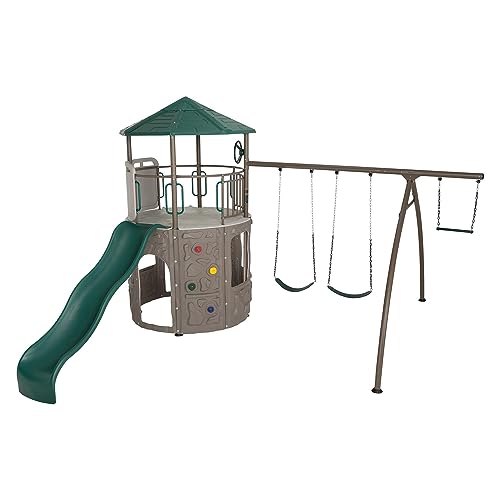
The Lifetime Adventure Tower, model 91200, is the simpler of Lifetime’s two Adventure Tower playsets on our site. It combines a roofed clubhouse, a 9-foot wavy slide, two 3-D climbing walls, two belt swings and a trapeze bar, all built from plastic and steel rather than cedar. This profile covers what Lifetime publishes, how much yard it needs, how it goes together and what upkeep to expect. For the full field, see our ranking of the best swing sets of 2026.
We do not test products ourselves. The details come from Lifetime’s model 91200 page and the English sections of its assembly manual, plus the CPSC’s home playground handbook. The Amazon listing for this ASIN is the earth-tone tower with two belt swings and a trapeze, matching the model 91200 feature list.
What Lifetime Says About the Adventure Tower
According to Lifetime’s page, the set includes:
- A 9-foot wavy slide made of UV-protected high-density polyethylene (HDPE).
- Two sturdy 3-D climbing walls.
- A covered clubhouse with a heavy-duty roof, plus a steering wheel and an integrated car map on the tower floor.
- Two swings and one trapeze bar, hung on rust-resistant zinc-coated chains with rubberized grips to prevent pinching.
- A roof and molded components made of HDPE, on a steel frame that Lifetime says passes playground performance and safety standards.
- A free-standing design that needs no cement.
Lifetime adds that hard edges are rounded or covered with plastic caps, that no lead-based material is used, and that the set is UV-resistant and will not crack, warp, rot or splinter. The page does not name a specific standard, so we do not either.
Size and the Yard Space It Needs
Lifetime’s manual lists the playset dimensions as 18 ft 1/2 in by 15 ft 2 in by 10 ft 9 in and the recommended play area as 31 ft 10 in by 31 ft 6 in. That is about 1,000 square feet of clear, level ground. It is a little smaller than the Deluxe but not by much.
The manual spells out the rules behind that area:
- Place the equipment on level, well-drained ground, not less than 6.6 ft (2.0 m) from any structure or obstruction such as a fence, garage, house, overhanging branches, laundry lines or electrical wires.
- Leave clearance in front of and behind the swings of at least twice the height of the swing bar.
- Cover the entire recommended play area with impact surfacing.
The CPSC handbook says much the same: at least 6 ft from structures, extra space in front of and behind swings equal to twice the height of the top bar, and surfacing at least 6 ft beyond the equipment in all directions. Lifetime’s 6.6 ft is slightly more generous.
The manual also says a slide can get hot in direct sunlight and that it is not recommended to install a slide facing the sun. Think about where the afternoon sun hits before you stake out the site.
If your yard is tight, compare the footprint numbers on our smaller-set profiles. The Gorilla Double Down II lists a recommended 28 ft by 25 ft total area, which is considerably less than the Lifetime towers.
Climbing, Sliding and Swinging
The Adventure Tower is a straightforward design: climb the walls or the entry, play in the clubhouse, then slide or swing. The two 3-D climbing walls give kids two routes up, and the roofed clubhouse gives some shade. The 9-foot slide is long for a home set and is made of UV-protected HDPE, but like any plastic slide it can get hot in full sun, as Lifetime’s own caution notes.
The swing beam holds two belt swings and one trapeze. Lifetime says the zinc-coated chains have rubberized grips. The manual says never to add extra length to chain or rope, and to teach children not to twist chains or loop them over the top support bar, to sit in the center of the swing with full weight on the seat, and to avoid swinging empty seats.
If you want monkey bars or a fireman’s pole, step up to the Lifetime Adventure Tower Deluxe. Lifetime’s page for this base model does not list them.
Weight Limits and Ages
Lifetime rates the Adventure Tower for ages 3 to 12, the top of the age range among the sets we cover. The manual says the playground is not suitable for children under three years, and that on-site adult supervision should be provided for children of all ages.
For capacity, the manual says the maximum number of occupants for the entire playset is ten, with a maximum combined weight of 1,000 pounds (454 kg). The English sections we read give no limits for individual parts. Gorilla’s manuals, by comparison, list limits for each swing, slide and platform. If your kids are near the top of the age range, read the full manual that ships with the set and keep the group size modest.
Assembly and Installation
Lifetime’s manual recommends three adults for setup, warns that parts can be damaged by overtightening and says everyone helping should wear safety glasses. The product page links an assembly video and offers a professional assembly quote request. We did not find an hour estimate in the sources we read, so plan for most of a day with helpers, and sort the hardware using the parts identifier first.
Practical points from the manual and the CPSC handbook:
- Pick level, well-drained ground. Lifetime says a level location reduces the chance the playset tips and that loose-fill washes away in heavy rain.
- Clear overhanging branches, stumps, roots, large rocks and bricks from the site.
- Although the set is free-standing, the manual includes an anchor installation section, with rods driven at least 12 inches into the ground. The CPSC handbook says to follow the manufacturer’s anchoring instructions and to cover anchors with surfacing.
- Do not install the set over concrete, asphalt, packed earth, grass, carpet or any other hard surface. The manual gives a maximum fall height for this product of 93 inches and recommends at least 9 inches of wood mulch.
The CPSC handbook adds that loose-fill such as wood mulch, wood chips, engineered wood fiber or shredded rubber should be maintained at a minimum depth of 9 inches for equipment up to 8 ft high, and that an initial 12 inches settles to about 9 inches over time.
Materials and Upkeep
The steel frame and HDPE roof and molded parts are the point of this set. Lifetime says no sanding, painting or staining is needed and that the plastic parts will not rot or splinter. Lifetime’s manual still lays out a schedule:
- At the start of each play season: tighten all hardware, lubricate metal moving parts, check protective coverings, inspect chains, seats and ropes for wear or rust, and rake and check the depth of the surfacing.
- Twice a month in play season: tighten hardware, check coverings and rake the surfacing.
- Once a month: lubricate metal moving parts and check swings, chains and ropes.
- At the end of the season or when the temperature drops below 40°F: take plastic swing seats and removable items indoors or do not use them.
- Sand and repaint any rust on metal parts with non-lead-based paint, per the manual.
A cedar set such as the Gorilla Double Down II needs sealing within its first 90 days and regularly after, so the Lifetime saves that chore but not the hardware checks.
Warranty
The manual includes a 5-year limited factory warranty to the original purchaser against defects in material or workmanship. Misuse, improper installation, alteration, accident, rusting and acts of nature are excluded, as are shipping charges and labor for removal or installation. It is non-transferable and does not apply to commercial or institutional use.
How It Compares With Neighbors
Against the Lifetime Adventure Tower Deluxe, this tower has the same slide, clubhouse and swing package on paper but no monkey bars or fireman’s pole on its page. The play area is slightly smaller. It sits lower in the range, so it is the one to pick if you want the Lifetime build without the extras.
Against the Backyard Discovery Buckley Hill, a compact cedar starter set, the Lifetime tower is much taller and needs far more yard, but it has a longer slide and a higher age rating.
Against the Gorilla Double Down II, you trade cedar and two slides for a plastic-and-steel build, no staining and a rating up to age 12 rather than 11. The Gorilla offers a 10-year lumber warranty against Lifetime’s 5-year factory warranty, and the Gorilla needs less total yard.
Who Should Buy It
- Families who want a low-maintenance set without staining.
- Parents of kids from preschool through about age 12, within Lifetime’s range.
- Buyers with roughly 32 ft by 32 ft of level, well-drained ground.
- Anyone who wants a tower, long slide and swings but not the extra climbing gear.
Who Should Skip It
- Families who want monkey bars or a fireman’s pole, who should look at the Deluxe.
- Small yards, since the play area is still about 1,000 square feet.
- Buyers who prefer natural wood.
- Parents of children under 3, since Lifetime says the playground is not suitable for them.
Measure, stake out the area, and order surfacing with the set. Setup, surfacing and supervision matter more than any feature list, and Lifetime’s manual and the CPSC handbook are the documents to follow.
Sources