We earn a commission if you buy through our links, at no extra cost to you.
Swing Sets for Big Kids Ages 8 to 12: What to Know
Which swing sets suit bigger kids ages 8 to 12: maker age ranges, weight limits, monkey bars, towers and the yard space they need, with five models compared.
At a glance
Lifetime Adventure Tower Deluxe is the pick for kids up to 12, since Lifetime lists ages 3 to 12 and it has monkey bars. Gorilla Playsets Double Down II suits kids up to 11 in a mid-size yard, and Backyard Discovery Montpelier adds a clubhouse.
Most swing sets are sold with a young child in mind, and the age ranges on the box show it. If your kids are 8, 10 or 12, the question is not which set has the cutest clubhouse. It is whether the structure is rated for their age and weight, whether it has things a bigger child still wants to do, and whether your yard can hold it. This guide goes through the five sets from our swing set ranking that make the most sense for older elementary and middle-school kids, with the makers’ own numbers and where we have to say that a number is not published.
We do not test products ourselves. Everything here comes from the manufacturers’ product pages and manuals and from the Consumer Product Safety Commission’s home playground handbook.
A Straight Answer on Age
Maker age ranges are the starting point, and they are lower than many parents expect:
- Lifetime lists ages 3 to 12 for its Adventure Tower and Adventure Tower Deluxe.
- Gorilla Playsets lists ages 3 to 11 for the Pioneer Peak and the Double Down II.
- Backyard Discovery does not print an age range on the Montpelier page. It says its swing sets have performance testing for children up to 11 years old.
So a 12-year-old is at the top of the only range that reaches 12, and past the ranges of the others. If you are shopping for a child of 11 or 12, the Lifetime sets are the straightforward match. For a child of 8 to 10, all five are within the makers’ ranges, and the decision comes down to features and yard space. We would not recommend any of these for teenagers.
ASTM F1148, the home playground standard that several makers cite, covers equipment used by children from over 18 months through 10 years, according to ASTM’s listing. That is another reason to treat the manufacturer’s age and weight limits as firm.
What Matters for Older Kids
Weight limits per part, not just the set. The set-wide number is rarely the one that limits you. Gorilla’s manuals list 800 lbs for fort platforms, 225 lbs for a swing belt, 125 lbs for a trapeze and 150 lbs for the rock wall and slides, with monkey bars at 175 lbs. The Pioneer Peak manual adds that 150 lbs is the maximum recommended swinging weight for a swing position. Lifetime’s manuals say the whole playset takes a maximum of ten occupants and 1,000 lbs. Backyard Discovery does not list limits on its product page, so you will need its manual.
Things to climb and hang from. Older children tire of a slide quickly. Monkey bars, rock walls, a trapeze, a fireman’s pole and a clatter bridge give them reasons to keep using the set.
Height and room. Bigger kids use taller platforms and swing harder, so surfacing and clearance matter more, not less. We cover the space rules below.
Upkeep. The cedar sets need seasonal checks and may need sealing. Lifetime’s plastic-and-steel sets say they need no sanding, painting or staining.
Lifetime Adventure Tower Deluxe
The only set here with a 12-year maximum age from its maker, plus monkey bars, a fireman's pole and two climbing walls for older kids.
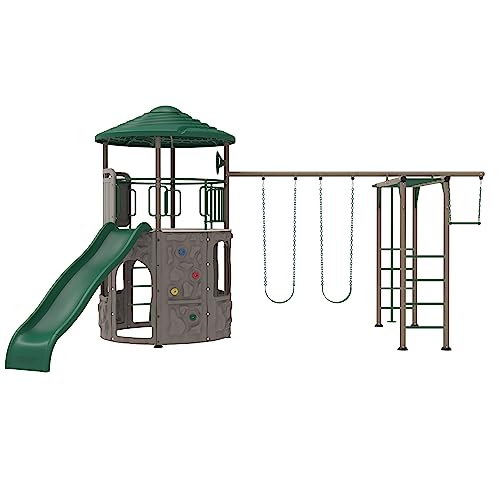
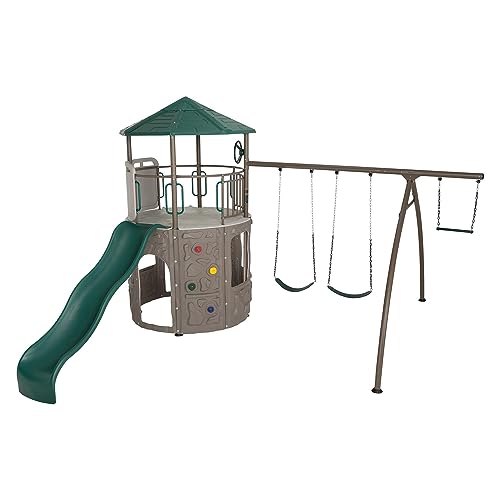
Lifetime describes the Deluxe as ideal for children ages 3 to 12, and it is the most complete climbing set in this group: a 9-foot wavy slide, monkey bars, two rock-style climbing walls, a fireman’s pole, a covered clubhouse with a hardtop roof, a ship’s wheel, two belt swings and a trapeze. The structure is double-wall high-density polyethylene with galvanized, powder-coated steel, which Lifetime says will not warp, rot or splinter and requires no sanding, painting or staining. Lifetime says the swing chains have soft rubber grips to prevent pinching. Our Adventure Tower Deluxe profile has the full specifications.
The manual says the set takes up to ten occupants and 1,000 lbs in total, recommends three adults for setup, and asks for at least 6.6 feet from any structure. The dimensions page in the manual shows a playset of about 16 ft 2 in by 19 ft 6 in and a recommended play area of 32 ft 6 in by 33 ft 3 in. Lifetime says the product passes playground performance and safety standards but does not name ASTM F1148 on its page, so we do not either.
Lifetime Adventure Tower
The same 3-to-12 age range as the Deluxe in a simpler tower with climbing walls, a clubhouse, a 9-ft slide and swings.
The base Adventure Tower drops the monkey bars and fireman’s pole but keeps most of the rest: a 9-foot wavy slide, two 3-D climbing walls, a clubhouse with a heavy-duty roof, a steering wheel, two belt swings and a trapeze bar. The chains are zinc-coated with rubberized grips. Lifetime says the set is free standing, with no cement needed, and describes the same low-maintenance HDPE and steel construction.
The manual lists the same ten-occupant, 1,000 lb maximum and the same recommendation of three adults for setup. Its dimensions page gives the playset as about 18 ft by 15 ft 2 in by 10 ft 9 in with a recommended play area of 31 ft 10 in by 31 ft 6 in. If your older child cares more about climbing walls than monkey bars, it is the more streamlined choice. See the Adventure Tower profile.
Gorilla Playsets Pioneer Peak
A large cedar structure with two towers, a clatter bridge, rock wall, rope ladder and climbing ramp for kids up to 11.
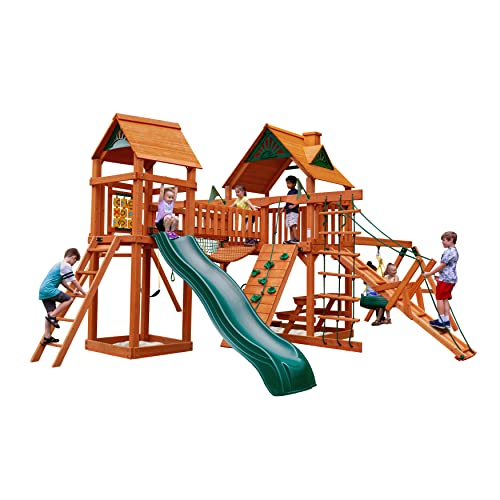
The Pioneer Peak is a big structure by any standard. Gorilla lists the assembled set at 23 feet wide, 22 feet 6 inches deep and 11 feet high with a main platform of 4 by 6 feet and a platform height of 5 feet. Two towers are joined by a clatter bridge, and there are a rock wall with a rope, a rope ladder, a climbing ramp, a trapeze, belt swings and a tire swing. For a child who wants a lot of different things to climb, that variety is the draw.
Gorilla’s manual lists ages 3 to 11 with the weight limits noted above. Gorilla lists 12 to 15 hours of assembly and offers professional installation, and with its 6-foot safety perimeter the set needs about 35 feet by 34 feet 6 inches. Read our Pioneer Peak profile for the full details.
Gorilla Playsets Double Down II
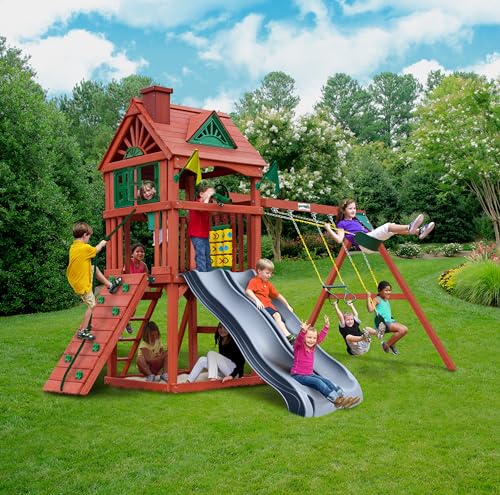
Two side-by-side wave slides, a rock wall and a trapeze in a mid-size cedar set for kids up to 11.
The Double Down II is the one for families with a mid-size yard. Gorilla recommends 28 by 25 feet in total, including the 6-foot perimeter, and the set has a rock wall with a climbing rope, two Alpine Wave slides, two belt swings and a trapeze on a three-position beam. Gorilla recommends it for ages 3 to 11 with an 800 lb total weight capacity. The deck is a compact 4 by 4 feet, so several big kids will feel crowded. See the Double Down II profile.
Backyard Discovery Montpelier
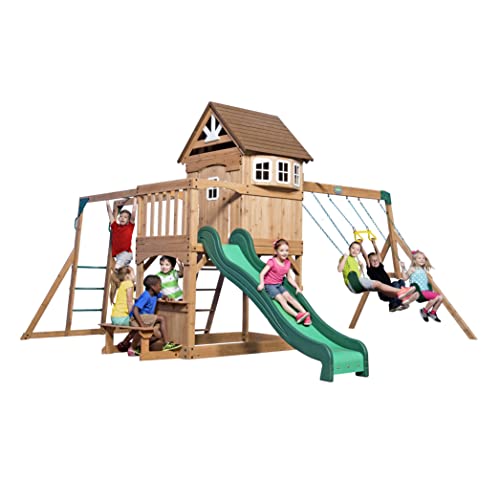
A cedar clubhouse set with monkey bars, a trapeze and an 8-ft slide for kids in the 8 to 11 range.
The Montpelier is the clubhouse option: a raised playhouse with a balcony, monkey bars, a trapeze, two belt swings and an 8-foot wave slide, in 100% cedar with a 5-year warranty according to Backyard Discovery. It is 193 by 185.75 inches, and the company says it is designed with multiple play areas for up to 8 kids. Because the page lists no age minimum or weight limits, read the manual before first use. See the Montpelier profile for the space calculations.
Yard Space and Surfacing for Big Kids
The CPSC handbook says to place equipment at least 6 feet from any structure or obstacle such as a house, fence, shed, tree or pole, with swings farther away to the front and rear, a distance equal to twice the height of the top bar. It recommends shock-absorbing surfacing under the equipment and at least 6 feet beyond it, and suggests at least 9 inches of loose fill for equipment up to 8 feet high, with rated material for taller structures. Lifetime’s manuals point to the same ASTM F1292 surfacing standard.
Other points from the handbook: keep S-hooks closed, check nuts and bolts twice a month, inspect swing seats, ropes and chains monthly, and supervise children. None of this makes any structure injury-proof.
Which One for Your Child
- Age 11 to 12: Lifetime Deluxe or Lifetime Adventure Tower, because they are the only ones rated to 12.
- Age 8 to 10 who loves climbing: Pioneer Peak if you have the yard, or the Lifetime Deluxe.
- Age 8 to 10 with a mid-size yard: Double Down II.
- Pretend play plus monkey bars: Montpelier.
Sources
- Lifetime Adventure Tower Deluxe official product page
- Lifetime Adventure Tower Deluxe (model 91199) assembly manual (source of the 1,000 lb limit, 6.6 ft clearance, setup and dimensions)
- Lifetime Adventure Tower official product page
- Lifetime Adventure Tower (model 91200) assembly manual (source of the limits and dimensions)
- Gorilla Playsets Pioneer Peak official product page
- Gorilla Playsets Pioneer Peak assembly manual (PDF) (source of the weight limits and ages)
- Gorilla Playsets Double Down II official product page
- Gorilla Playsets Double Down II assembly manual (PDF)
- Backyard Discovery Montpelier official product page
- CPSC Outdoor Home Playground Safety Handbook (PDF)
- ASTM F1148-24 Standard Consumer Safety Performance Specification for Home Playground Equipment
Frequently asked questions
What is the best swing set for a 12-year-old?
Only Lifetime lists a maximum age of 12 among the sets we cover, for both its Adventure Tower and Adventure Tower Deluxe. Gorilla Playsets lists 3 to 11, and Backyard Discovery says its sets have performance testing for children up to 11. A 12-year-old is at or past the top of most makers' ranges, so check the manual's weight limits too.
How much weight can a swing set hold?
It depends on the component. Lifetime's manuals give a maximum of ten occupants and 1,000 lbs for the whole playset. Gorilla's manuals list 800 lbs for fort platforms, 225 lbs for a swing belt, 125 lbs for a trapeze, 150 lbs for the rock wall and slides, and 175 lbs for monkey bars. Gorilla's Pioneer Peak manual adds that 150 lbs is the recommended maximum swinging weight for a swing position.
Are monkey bars good for bigger kids?
They give older children something to climb and traverse, which is why Lifetime's Adventure Tower Deluxe and Backyard Discovery's Montpelier list them. Gorilla's manual caps its monkey bars at 175 lbs, so check the limit for the set you pick.
How much space does a big-kid swing set need?
More than a starter set. The CPSC handbook calls for 6 feet of clear space around the structure and twice the beam height in front of and behind swings. The makers' own recommended areas run from about 28 ft by 25 ft for the Double Down II to about 32 ft 6 in by 33 ft 3 in for the Lifetime Deluxe.
Can adults use a kids' swing set?
The makers rate these sets for children. Check each swing's weight limit in the manual and treat it as a limit for children. Gorilla's manual, for example, lists 225 lbs for a swing belt but says 150 lbs is the maximum recommended swinging weight for the position.
What surface should go under a swing set?
The CPSC handbook recommends loose fill such as wood mulch, engineered wood fiber, shredded rubber mulch, sand or pea gravel, or rubber surfacing rated to ASTM F1292, extending at least 6 feet beyond the structure. It recommends at least 9 inches of loose fill for equipment up to 8 feet high. Grass and concrete are not suitable.